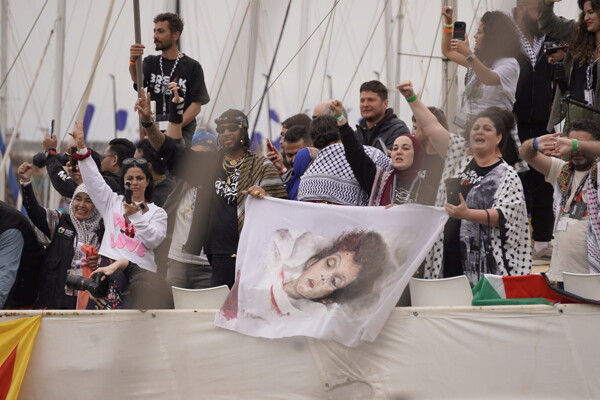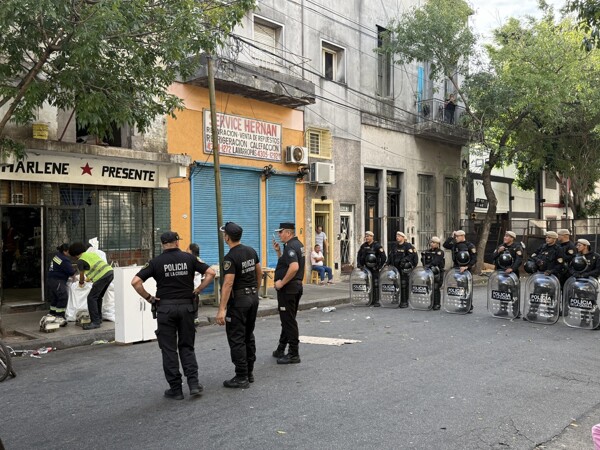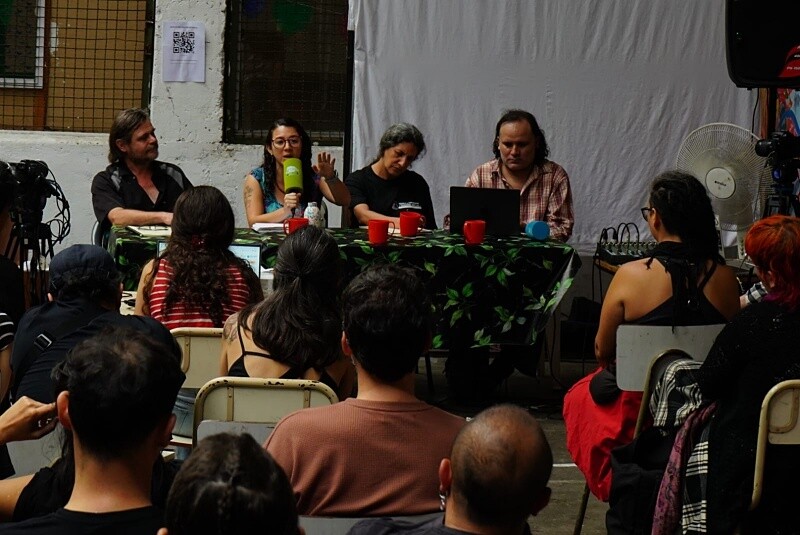
With a strong focus on memory, more than 20 social and community organizations from across Latin America came together in an initiative that combined technical training, political reflection, and direct mobilization. This meeting took place against a backdrop of constant tensions in the region due to the advance of the right-wing worldwide, with fascist-style governments perpetuating the neoliberal model. The second edition of the Common School of Communication and Free Technologies for the Common Defense of the Territory was held in Buenos Aires, bringing together representatives from eight countries. It is a space for meeting and sharing community communication and technologies for the defense of territories and popular struggles. In this sense, participation in the mobilization was also an instance of collective learning to weave, articulate, and strengthen struggles and territories through the construction of networks and shared experiences. This is where the importance of communication as a current and powerful tool to keep alive the utopia of a more just society lies. Through workshops and group practices, participants strengthened their capacities to produce, safeguard, and manage information in a safe and collective manner. A central aspect of the Common School is the use of free technologies and autonomous servers, conceived as 'digital gardens' that allow organizations to store their data outside of major corporate platforms. Using video to document these abuses constitutes a central tool to make these realities visible and to position the demands of the oppressed against a power that ravages lives and territories. 50 years after the coup, neither pardon, nor reconciliation, nor forgetting. At least one million people occupied the streets of Buenos Aires on March 24, 2026, raising the slogan for Memory, Truth, and Justice, but also reaffirming that five decades after the coup there is and never will be any possibility of pardon, reconciliation, or forgetting, as expressed by the Mothers of Plaza de Mayo during the reading of the closing manifesto of the massive popular mobilization, one of the most symbolic and emotional moments of the day. The coverage of the march carried out by the participants of the Common School was integrated into a broader regional articulation process, where community communication was consolidated as a key tool to make social struggles visible and strengthen active memory in Latin America, becoming this action a fundamental component of the pedagogical process. Dialogues Without Borders. Together with the Polo Técnico de Izquierda, the Common School held an open dialogue called Dialogues Without Borders, being the second edition of this activity. In the face of the digital latifundia that dominate this era of concentrated and privatized internet, the Common School of Communication and Free Technologies for the Common Defense of the Territory encourages organizations to be able to cultivate community digital gardens to safely store their information and offer services to their communities. From March 19 to 29, 2026, the second edition of the School of Communication and Free Technologies for the Common Defense of the Territory was held in Haedo, Buenos Aires Province, Argentina, a process of training, memory, and collective action. The knowledge shared during those days found its axis of action in the March 24th March for Memory, Truth, and Justice. In 2026, the Common School was consolidated as a platform to build its own tools, share strategies, and weave networks among organizations that face common problems in their territories, exposed to the constant threat of extractive industries, land dispossession, labor precariousness, regression of rights, and other aspects that multiply in the region. The School works around three pedagogical axes: I) Documentation: audiovisual recording of human rights violations and threats to nature, which in this edition focused on police violence. II) Digital gardens: development of autonomous digital infrastructures. III) Comprehensive care: where comrades with extensive experience presented different theoretical-practical perspectives on self-care, digital security, collective and community protection, among others. This approach aims to dispute the control of information in a context of growing digital concentration, promoting alternatives based on technological sovereignty and collective management. In the face of the digital latifundia that dominate this era of concentrated and privatized internet, the Common School proposes that organizations be able to cultivate community digital gardens to safely store their information and offer services to their communities. This year there was a very significant leap in terms of the pedagogy around this axis. The process had as its precedent four previous virtual sessions before the in-person phase, in which all aspects to be developed during the stay in Buenos Aires were organized and planned, and the first contents to be deepened during the in-person phase were addressed. For ten days, the initiative functioned as a space for exchange and collective learning where technical knowledge, territorial experiences, and political reflection were combined, with the aim of strengthening community communication and the defense of rights in the region. The creation of a common language as well as a safe space were key factors highlighted by the participants who went through this process, managing to get their autonomous servers up and running and ready to start their projects. The proposal of the Common School transcends the technical, as it understands that the latter is subordinate to the political. Thus, communicative training is articulated with processes of memory, narratives, and the dispute of meaning, turning communication into a trench of struggle from a counter-hegemonic and transformative perspective. Memory that agitates the slogan for truth, reparation, and justice. Memory is not limited to the past; it is what happened, but also what is happening now and what we are going to build for the future. From morning to afternoon, there were talks on popular communication with Red de Medios Alternativos (RMA), Common School, and Radio 8 de Octubre; and environmental monitoring with CoSensores, Polo Técnico de Izquierda, Coatí, Project Hábitat, and CoMapeo. Dialogues Without Borders was also held in the first edition of the Common School, and the material can be found on the Common School's webpage. One of the most emotional aspects of bringing together about 50 participants of the Common School was related to the commemoration of the 50th anniversary of the civic-military coup that occurred on March 24, 1976, in Argentina. Forced disappearances, repression, and the criminalization of protest continue to be present in the region and are not the exception but the rule in other latitudes of the continent, as is the case of Mexico, where to date more than 135,000 forced disappearances have been denounced as a result of political and criminal violence that has now become the constant that has taken over the north, center, and south of Latin America. Thus, the slogan for memory, truth, reparation, and justice is more relevant than ever and unites all our peoples in the same struggle. More than 20 organizations from 8 countries carried out collaborative coverage 50 years after the civic-military coup in Argentina, which left the nefarious balance of more than 30,400 brothers and sisters disappeared.